
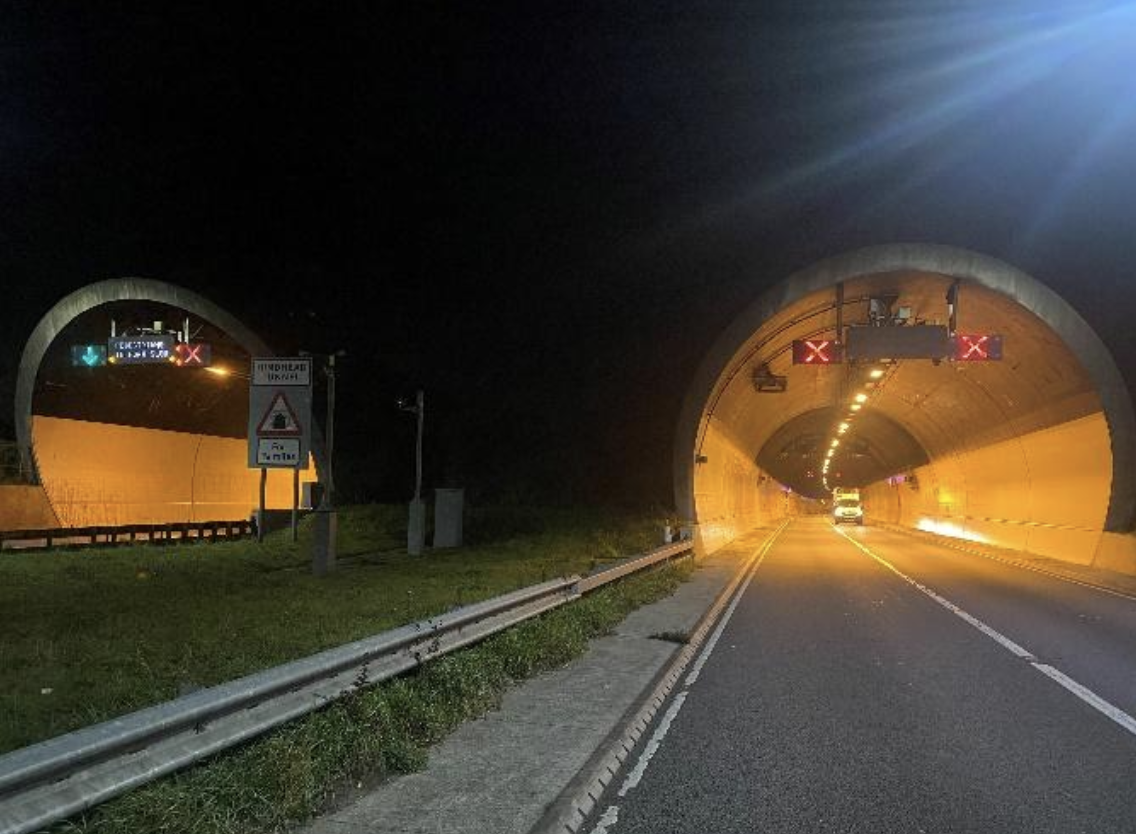

Why access is the constraint that shapes everything else
Ask a road user what happens when a tunnel needs electrical work and most will assume the answer is simple: close it, fix it, reopen it. Ask a tunnel operations manager the same question and you’ll get a very different answer.
Closing a tunnel on the strategic road network is never the preferred option and is done as a last resort. Diversions can push large volumes of traffic onto roads that were never designed to carry them, increase journey times, create additional safety risks and cause disruption far beyond the tunnel itself. The commercial cost of congestion is therefore significant, and operators are under constant pressure to keep critical routes available – so the work often has to happen around the traffic, not instead of it.
In a live tunnel, the technical task may be familiar enough: maintain a ventilation fan, replace lighting, inspect switchgear, repair a distribution board, install new controls, upgrade signage or carry out remedial work. What makes the project difficult then is not necessarily the component itself. It is the fact that access to it may only exist for a few hours, at night, under a tightly controlled closure or lane restriction, with the tunnel expected to return to normal operation at a fixed time.
That single constraint changes almost everything about how the work is planned and delivered.
The access window defines the programme, not the other way around
On a conventional construction site, you normally start with the scope. You identify what needs to be installed or repaired, estimate how long it will take, build a programme and then organise labour and materials around that programme.
A live tunnel works almost in reverse. The window is established first, and the task is then to design the work around it. You may be told that a single bore is available between midnight and 4am. Or that one lane can be closed for three hours while another remains live. Alternatively, that a weekend possession is available several months from now, but only if the asset is fully returned to service before Monday morning.
This makes tunnel programmes much more granular. A job that might normally be treated as one continuous task has to be broken down into individual stages that can each be completed, tested and safely handed back within the available access.
That could mean separating:
- inspection from repair
- dismantling from refurbishment
- installation from commissioning
- cable preparation from final termination
- survey work from physical intervention
- testing from permanent replacement
Access is a shared resource. Electrical teams may not be the only people working inside the tunnel during a closure. Mechanical teams, civils contractors, fire-system specialists, cleaning crews, drainage contractors, structural inspectors and communications engineers may all need access to the same space.
A four-hour closure does not necessarily mean four productive hours for every contractor.
There is traffic management to establish, permits to issue, isolations to complete, access equipment to position and multiple work parties to coordinate before the physical task can even begin.
At the end of the window, the same process happens in reverse – tools have to be removed, equipment proven, temporary works cleared, etc. If the carriageway must reopen at 5am, the work cannot still be finishing at 4:59.
That is why experienced tunnel teams programme backwards from handback rather than forwards from mobilisation.
Closures are longer than active work
This is one of the biggest misconceptions about tunnel maintenance.
If a closure is booked from midnight until 4am, it is easy to assume there are four hours available for engineering.
In practice, the usable working period can be considerably shorter.
Part of the window may be consumed by:
- traffic management
- access verification
- electrical isolation
- permit-to-work procedures
- atmosphere or environmental checks
- safe access to shafts or plantrooms
- lifting operations
- equipment setup
- testing
- reinstatement
- commissioning
- Sign-off and final inspection before handback
That makes productivity inside the tunnel extremely valuable. An hour lost because the wrong lifting accessory has been brought to site can mean the entire task has to be abandoned and rescheduled.
This is why apparently minor logistical mistakes have an outsized impact in live infrastructure.
Prepare what work you can
The single biggest lever on live-tunnel delivery is how much work can be completed away from the tunnel. Everything pre-staged, pre-assembled, pre-configured or pre-tested off-site is time that does not have to be spent inside the access window.
That principle applies across tunnel M&E. A ventilation fan impeller can be removed and sent away for dynamic balancing rather than trying to complete specialist refurbishment work within the shaft.
Control equipment can be configured before it arrives, panels can be assembled and tested in a controlled environment, cable assemblies can be prepared to length and replacement components can be checked against existing equipment before mobilisation.
Materials can be grouped into installation-specific kits rather than delivered as a general pile of stock, and paperwork can be prepared in advance.
If everyone already understands the RAMS, sequence, responsibilities and testing criteria before the closure begins, less time is spent resolving basic questions once access is live.
The same applies to condition information. If vibration analysis, thermal imaging, insulation resistance testing or previous maintenance records already indicate what is likely to be wrong with an asset, the engineering team can arrive with the right replacement parts and tools.
That way, we are not discovering the problem for the first time at 1am. The contractor who leaves preparatory work until inside the access window has already made the job harder than it needs to be.
Survey properly before the work starts
Good pre-planning depends on knowing what is actually there. Drawings are useful, but tunnel assets often have long operating histories. Equipment may have been modified, replaced, relocated or adapted over several maintenance cycles.
A proper survey can therefore be the difference between a clean installation and a wasted closure.
Before undertaking significant works, the project team may need to establish things such as exact asset dimensions, cable routes, termination arrangements, access restrictions, lifting requirements and more.
Measurements should be reliable enough for off-site fabrication. Photographs should show enough detail for engineers planning the work later. Where possible, the site team should identify anything that could prevent the task being completed within the planned window.
A measurement missed during the survey can become a serious problem once the fabrication team discovers the new equipment will not fit.
Isolate the asset, not the whole tunnel
Modern tunnel systems are designed with redundancy, and that redundancy is one of the things that can make maintenance possible without completely taking the tunnel out of service.
A ventilation system may have multiple fans. Lighting can be divided across circuits or sections. Electrical distribution may allow individual assets to be isolated, while the wider system remains operational.
Communications or emergency systems may have resilient architectures designed to tolerate individual components being unavailable.
The objective is therefore often to isolate the smallest safe part of the system required to complete the work. That sounds simple, but it requires detailed understanding of system interdependencies.
A single ventilation fan may be physically isolated, but what does that do to overall airflow? Does another fan automatically take over? Does the system still meet the operating strategy for pollution control? What happens if there is an incident while the fan is unavailable? Can emergency smoke extraction still operate as required?
Likewise, isolating one electrical distribution circuit may affect equipment that is not physically located near the work area.
Tunnel infrastructure is interconnected. The person making the isolation decision has to understand the system as an operational whole rather than as a collection of independent electrical components. That is one of the reasons live-tunnel experience matters.
A contractor who is technically competent at electrical installation but unfamiliar with tunnel operations may see an isolation that looks perfectly acceptable on a schematic without appreciating its operational consequences.
Redundancy is only useful if you understand it
There is a difference between knowing redundancy exists and knowing how it behaves during maintenance.
A tunnel may have duty and standby equipment, dual power supplies, multiple ventilation paths or duplicated control systems. But redundancy is rarely as simple as “turn one off and the other one takes over.”
The maintenance team needs to understand:
- automatic changeover behaviour
- control logic
- alarm states
- temporary operational restrictions
- degraded-mode operation
- emergency response requirements
- what additional failures can still be tolerated
If one side of a redundant system is under maintenance, the tunnel may temporarily have less resilience than normal. That can affect what other works are allowed at the same time. It may also change the operator’s contingency plan.
Good tunnel maintenance therefore involves close coordination with the control room and operational team, not simply the electrical engineer performing the isolation.
Sequence the work for handback, not completion
The measure of a successful night is not how much work was attempted, but rather whether the tunnel goes back into service safely and on time. That changes the way tasks are sequenced.
On an ordinary project, the natural sequence may be to complete as much installation as possible and then carry out testing towards the end. But in a live tunnel, that can be dangerous from a programme perspective.
If testing is left until the last half-hour and something fails, there may be no time to diagnose the problem and restore the asset before the carriageway has to reopen.
So work should be broken into stages with defined handback points. Testing and commissioning are built into the programme rather than bolted onto the end.
The project team should know:
- the latest point at which installation can continue
- when testing must begin
- when the decision to stop further work has to be made
- what the safe fallback condition is
- how long reinstatement takes
- how much contingency has been allowed
This often means deliberately stopping productive installation before the closure technically ends. That can feel counterintuitive, but if the final 45 minutes are required to test, document, reinstate and prove the asset, using those 45 minutes for more installation is not productive. It creates handback risk.
Always know the point of no return
Every significant live-tunnel task should have a moment beyond which the team should not start another stage of work. That point needs to be decided before the night begins.
Imagine a component replacement normally takes 90 minutes.There are 100 minutes of access remaining. Technically, it might fit, but if the component does not seat correctly, a cable termination needs remaking or commissioning identifies a fault, there is no contingency.
The correct decision may therefore be not to start. That can be frustrating, particularly after significant mobilisation effort. But live infrastructure requires this kind of discipline.
The objective is not to extract every possible minute from the closure. It is to make sure the asset can be returned to service reliably.
Experienced teams recognise that sometimes the safest and fastest decision is to stop.
Testing and commissioning are part of the work
Physical installation is only one part of a tunnel electrical task.
If an asset has been replaced or disturbed, it needs to be demonstrated that it is safe and functioning as intended before the system is handed back.
Depending on the asset, that could involve:
- electrical testing
- functional testing
- control-system verification
- alarm testing
- rotation checks
- vibration measurements
- operational proving
- emergency-mode testing
- remote-control verification
For a ventilation system, for example, it is not enough that the fan rotates. Does it rotate in the correct direction? Does it achieve the required operating condition? Has vibration been checked? Can the tunnel operator see its status correctly?
The same principle applies throughout M&E infrastructure. An installation that looks complete but has not been proven cannot simply be assumed to be ready for service.
Documentation happens during the closure, not afterwards
Tunnel maintenance records are operational documents.
They are not simply evidence produced for invoicing.
Engineers may not have easy access to that asset again for weeks or months. Once the tunnel is reopened, the photographs, test records and inspection notes taken during the work may be the only current record of its condition. That makes documentation part of the physical task.
And “fan repaired and tested” tells the next maintenance team almost nothing. A proper record should allow someone who was not present to understand what was found, what was done, what was measured and what condition the asset was left in.
Coordinate with the control room throughout the work
Tunnel maintenance is closely tied to operations.
Before isolation, operators need to understand which assets are being taken out of service. During the work, they may need to monitor alternative systems or operate in a temporary degraded mode. And after the work, they need confidence that the asset has returned correctly.
Communication should therefore be continuous rather than limited to the beginning and end of the shift. That shared situational awareness becomes particularly important if something unexpected happens elsewhere in the tunnel during the maintenance window.
Plan for the night going wrong
Live-tunnel work should be planned on the assumption that something may not go exactly as expected. That does not mean expecting failure; It means removing the element of surprise from foreseeable problems.
The project team should already know what happens if, for example, the isolation cannot be achieved, an existing component is more damaged than expected, fixings cannot be removed, or the replacement part does not fit. There may also be external issues such as another emergency takes priority, or the working window is shortened.
Full RAMS, approved lift plans and contingency procedures are part of this. But contingency also means knowing when to abandon the planned work and return the asset to its original state.
What tools are required to reinstate it? Is the removed component reusable? Is there a temporary safe configuration? What parts need to be held as spares? And who has the authority to make the decision?
These questions are much easier to answer at 2am, if somebody answered them at 2pm several weeks earlier.
The weather outside can affect the work inside
Road tunnels may appear sheltered, but the wider environment can still affect maintenance activity.
Heavy rainfall can increase drainage loads, cold conditions can affect equipment or access. And traffic incidents elsewhere on the network can delay or cancel planned closures. An emergency will take priority over maintenance as well.
A closure that has been booked for months is never entirely guaranteed until the tunnel is actually handed over. This creates another reason to maximise off-site preparation.
Planned maintenance reduces the number of emergency windows
The most efficient tunnel intervention is often the one that never becomes an emergency. Routine inspection and planned preventative maintenance allow deterioration to be identified early.
Electrical testing can highlight components moving towards failure, or inspection can identify corrosion, damaged seals, contamination or loose connections. Those findings can then be planned into future access windows with the right materials and labour already prepared.
By contrast, reactive failure doesn’t allow for the planning time that’s really needed. This is when closure may be needed immediately, parts may not be available, and traffic disruption becomes unavoidable.
This is why live-tunnel delivery is only partly about executing maintenance efficiently, but is also about using maintenance information to reduce unplanned interventions in the first place.
Final thoughts
Delivering electrical works in a live tunnel isn’t ordinary electrical work done in an awkward place. It is a discipline built around a constraint that many contractors rarely encounter: the infrastructure still has to operate, access is tightly controlled, the working window is fixed and handback is non-negotiable.
The strongest tunnel contractors plan backwards from reopening time rather than forwards from the start of the job.
Hybrid Electrical Solutions delivers specialist M&E maintenance and electrical works in live tunnel and transport-infrastructure environments across the UK. Our capability includes planned preventative maintenance, remedial works, electrical installation, asset upgrades and reactive support, with delivery planned around restricted access windows and the operational requirements of critical infrastructure.
If you are planning a tunnel maintenance, repair or upgrade programme, speak to us about how the works can be structured around access, isolation, testing and handback from the outset.