
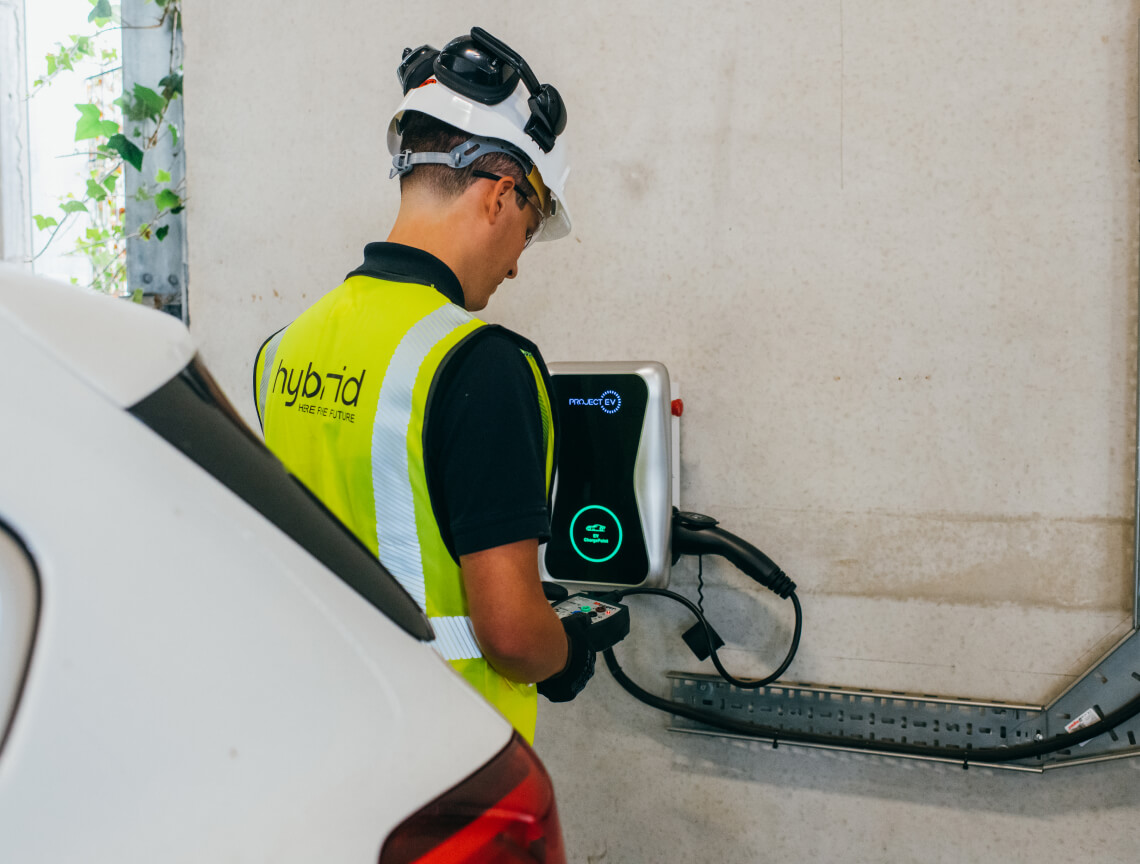

Installing EV chargers at your workplace is a practical step towards supporting staff, visitors, fleet vehicles and long-term sustainability goals. However, choosing the right charger is not simply a case of picking the fastest option available.
The best workplace EV charging solution depends on how the site is used, how long vehicles stay parked, how much electrical capacity is available and whether the chargepoints need to be private, shared or publicly accessible.
This guide explains the main options for businesses, landlords, fleet operators and public-sector teams planning a commercial EV charging installation.
Start with How the Site Will Be Used
The right EV charger depends on who will be using it. A workplace car park used mainly by employees will usually have very different charging requirements from a retail site, fleet depot or public charging location.
For staff parking, vehicles may be on site for a full working day, which often makes slower, lower-cost charging more practical. For visitors or customers, the charging session may be much shorter, so a faster charger may be more appropriate.
Fleet vehicles introduce another set of requirements. A business may need vans or cars charged at specific times so they are ready for scheduled routes, shifts or deliveries. Residential developments, hotels, leisure venues and public-sector sites may also need different access, billing and reporting arrangements depending on who is allowed to use the chargepoints.
Before choosing a charger, the first question should be: who needs to charge, how often and for how long?
Understand Vehicle Dwell Time
Vehicle dwell time is the amount of time a vehicle is expected to remain parked at the site. This is one of the most important factors in workplace EV charging design.
If vehicles are parked for several hours, such as during a working day or overnight, fast AC charging may provide enough power without placing unnecessary pressure on the site’s electrical infrastructure. This can be particularly suitable for offices, warehouses, depots, residential developments and hotels.
Where vehicles only stop for a short period, rapid DC or ultra-rapid charging may be more suitable. This is more common for public charging, fleet operations, retail destinations, motorway-style stops and commercial sites where drivers need to add range quickly.
Choosing a charger without considering dwell time can lead to overspending on unnecessary equipment or installing chargepoints that are too slow for how the site is actually used.
What Is Fast AC Charging?
Fast AC charging is commonly used for workplace EV charging because it suits vehicles that remain parked for several hours. These chargers are often installed in staff car parks, office developments, residential schemes, hotels and longer-stay commercial locations.
AC chargers are typically more cost-effective to install than rapid DC chargers and may place less demand on the site’s electrical supply. For many businesses, they offer a practical balance between charging speed, infrastructure cost and day-to-day usability.
Fast AC charging can work especially well where staff or fleet vehicles arrive in the morning and leave later in the day. Rather than charging a vehicle as quickly as possible, the system can provide steady charging while the vehicle is already parked.
For many workplaces, this makes AC charging the most sensible starting point.
What Is Rapid DC Charging?
Rapid DC charging is designed for situations where vehicles need to charge more quickly. These chargers are often used at fleet depots, retail sites, public charging locations and commercial settings where drivers cannot leave their vehicles plugged in for several hours.
Unlike AC chargers, DC chargers convert power before it reaches the vehicle, allowing compatible vehicles to charge at higher speeds. This can be valuable where vehicle availability is critical, such as fleet operations, delivery routes or high-turnover parking areas.
Rapid charging usually requires more detailed electrical planning. The site may need greater available capacity, upgraded distribution equipment, larger cable routes and more careful load management.
A rapid DC charger can be the right choice, but only where the site’s power supply, user demand and commercial case support it.
What Is Ultra-Rapid Charging?
Ultra-rapid charging is designed for high-demand environments where compatible vehicles need to charge in the shortest practical time. It may be suitable for motorway-style stops, major public charging locations, busy retail destinations or large fleet operations.
These chargers can be powerful, but they also require significant planning. The installation may involve detailed capacity assessment, DNO liaison, civil works, transformer or supply upgrades, load management and a clear understanding of how many vehicles are likely to charge at once.
Ultra-rapid charging is not always the best option for a standard workplace. If vehicles are parked for a full day, the extra cost and electrical demand may not be justified.
For high-use public or fleet environments, however, ultra-rapid charging can form part of a carefully designed commercial charging strategy.
Check Your Available Electrical Capacity
Your site’s available electrical capacity will heavily influence the type and number of chargers you can install. Before recommending a charger, a commercial EV installer should review the incoming supply, current site demand, distribution infrastructure and likely future requirements.
A site with spare capacity may be able to add several chargers without major upgrades. A site already operating close to its available supply may need a more considered design, especially if rapid or ultra-rapid charging is being considered.
Dynamic load management can help make better use of the power already available. It distributes power between chargers and can reduce charging speeds when site demand is high, helping to avoid exceeding the agreed capacity.
This can allow businesses to install more chargepoints without immediately committing to expensive supply upgrades, although every site should be assessed individually.
Think About Payment and Access Control
Workplace EV charging is not only about hardware. Businesses also need to decide who can use the chargers, how users will access them and whether charging will be free or paid.
Some workplaces may offer free staff charging as an employee benefit. Others may use RFID cards, app access or driver accounts to manage usage and recover electricity costs. Fleet-only charging may need different rules again, especially where vehicles are assigned to drivers, routes or departments.
If chargers are available to visitors, residents, customers or members of the public, payment systems and usage reporting become more important. Publicly accessible chargers may also need to meet additional operational and payment requirements.
Choosing the right software platform can make it easier to monitor charger usage, manage users, set tariffs, produce reports and maintain control over the charging network.
Choose the Right Charger Format
The physical format of the charger also matters. Wall-mounted units can work well where chargers are being installed close to a suitable building, wall or internal car park structure. Pedestal-mounted chargers are often better suited to open car parks, rows of parking bays and sites where chargers need to stand independently.
There is also a choice between tethered and socketed units. Tethered chargers include a fixed cable, which can make them convenient for regular users. Socketed chargers allow drivers to use their own cable and may be preferred in shared or public environments.
Parking layout, cable routes, accessibility, impact protection, lighting, signage and user behaviour all affect the final choice. A poorly positioned charger can be inconvenient, vulnerable to damage or difficult for drivers to use safely.
This is why charger selection should be part of the wider site design, not treated as a standalone product decision.
Plan for Future Expansion
EV charging demand is likely to grow, so it is worth planning beyond the first installation. Even if your business only needs a small number of chargers today, future staff, tenant, customer or fleet demand may increase quickly.
A future-ready design might include spare cable routes, ducts, distribution capacity, additional mounting locations, scalable software and space for more chargepoints. This can make later phases easier and less disruptive.
Phased rollout can also help businesses manage budgets. Instead of installing every charger at once, the site can be prepared for expansion while only commissioning the chargepoints needed immediately.
Planning ahead helps avoid the common problem of installing an initial system that becomes difficult or expensive to extend later.
Could Solar PV or Battery Storage Help?
Solar panels and battery storage can support workplace EV charging as part of a wider energy strategy. Solar PV can help generate electricity on site, reducing reliance on the grid when generation and charging demand overlap.
Battery storage may allow a business to store surplus solar electricity or lower-cost off-peak electricity, then use it later to support EV charging. This can be useful for managing peak-time demand, improving self-consumption and making better use of available energy.
For fleet sites, solar and battery storage may help optimise charging schedules, especially where vehicles return at predictable times or remain parked overnight.
The best approach depends on the site’s electricity use, solar generation potential, charging demand and available electrical capacity. EV charging, solar PV and battery storage should be assessed together where possible.
How Hybrid Asset Solutions Can Help
Hybrid Asset Solutions designs, supplies, installs and maintains commercial EV chargepoints for workplaces, fleet depots, residential developments, commercial property, hospitality sites, public-sector estates and publicly accessible locations.
Our team can support the full process, from site survey and electrical-capacity assessment through to charger specification, system design, installation, commissioning, software setup and ongoing maintenance.
We can advise on fast AC charging, rapid DC charging and ultra-rapid charging, depending on your site requirements, available power, vehicle dwell times and commercial objectives. We can also support practical planning around charger location, parking layout, cable routes, load management, payment systems, user access and future expansion.
Whether you need a single-site installation or a larger multi-site rollout, Hybrid can help you plan EV charging infrastructure that is practical for your users today and scalable for the future.
Plan Your Commercial EV Charging Installation
Tell us about your site, the number of vehicles you need to charge and how the chargepoints will be used. Our team will review your requirements and recommend the right EV charging solution for your workplace, fleet or commercial environment.
From initial advice to installation and ongoing maintenance, Hybrid Asset Solutions can help you make confident decisions about your commercial EV charging infrastructure.
Contact Hybrid Asset Solutions to discuss your workplace EV charging installation.