
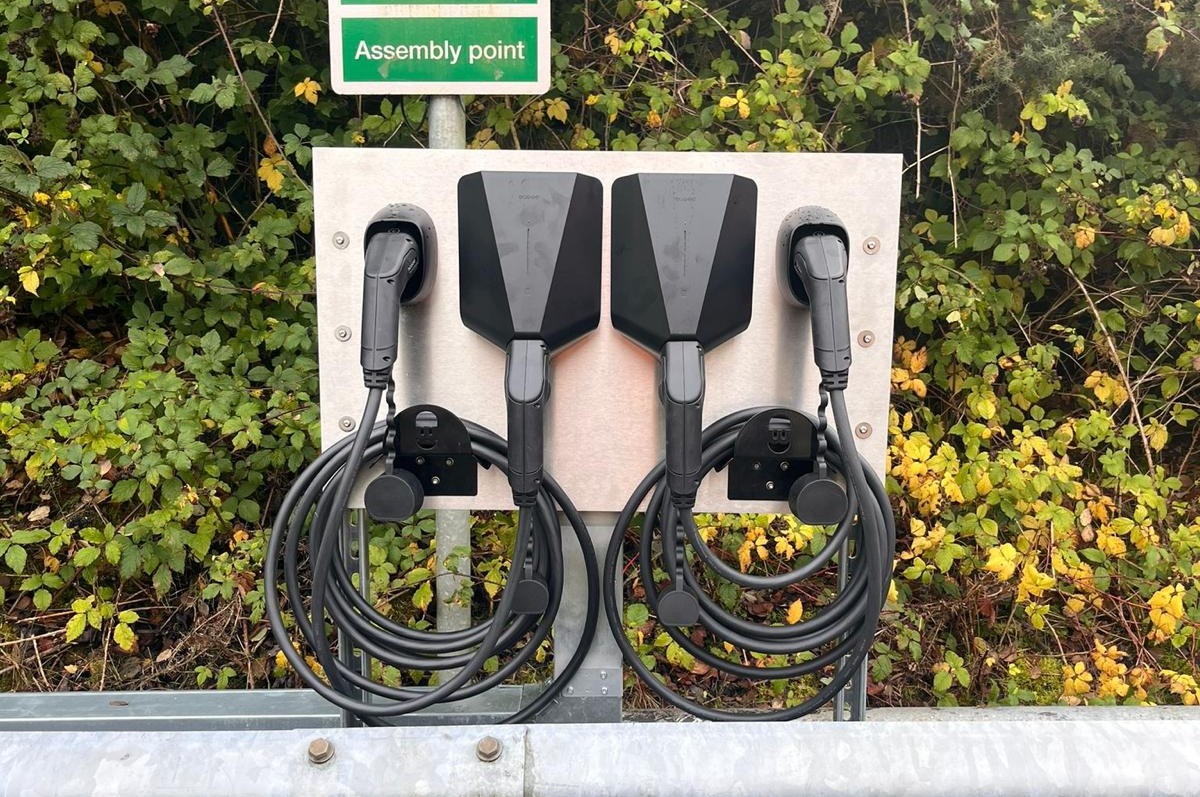

Electric vehicle chargepoints are increasingly becoming part of the basic infrastructure businesses need to think about rather than an optional sustainability extra.
The business case is also broader than simply being able to say your organisation supports electric vehicles.
For an office, EV charging might help employees who cannot conveniently charge at home. For a hotel or leisure venue, it can improve the customer experience. For a logistics or service business, the priority may be preparing for an electric van fleet. For a commercial landlord, it can be about making a property more attractive to existing and prospective tenants.
In some cases, chargers can generate revenue directly. In others, the value comes from staff retention, fleet efficiency, property competitiveness or avoiding a much more difficult infrastructure upgrade several years down the line.
That means there isn’t one standard return-on-investment calculation for commercial EV charging. A strong business case starts by asking who will use the chargers, how long vehicles will be parked, how much electricity the site can provide and what the organisation wants the charging infrastructure to achieve.
Why EV charging is becoming a commercial priority
For a long time, commercial EV charging could be approached as a future consideration.
A business might install a couple of chargers to demonstrate an environmental commitment, but leave any significant infrastructure decisions until electric vehicles became more widespread.
That approach is becoming harder to justify, however. Employees, customers and commercial fleets are increasingly using electric vehicles, while organisations planning vehicle replacement programmes need to think about charging infrastructure before the vehicles actually arrive.
No depot owner wants to buy the vans first, then discover that the premises does not have sufficient electrical capacity, appropriate parking arrangements or the infrastructure needed to charge them overnight.
The same applies to property owners. An office building might only have demand for four chargers today, but if that rises to 20 over the next few years, the most important question isn’t necessarily whether to install four or 20 chargers immediately – but whether the electrical and civil infrastructure being installed now will allow the site to expand without starting again.
All 20 chargepoints don’t have to be installed right away, but it’s better if the capability to scale is there. EV charging is therefore becoming as much an infrastructure-planning question as an environmental one.
Supporting employees, visitors and customers
Workplace charging can solve a practical problem for employees who drive electric vehicles. Not every employee has access to off-street parking at home, while others may be travelling significant distances or using their car throughout the working week.
If their vehicle is already parked at work for seven or eight hours, that creates an obvious opportunity to charge it. For employers, providing that facility can become part of the wider workplace package.
It supports causes such as employee convenience, staff retention and recruitment, company-car schemes and workplace sustainability initiatives.
The same principle applies to visitors and customers, but the charging requirement can be very different. The fastest charger is not automatically the right charger.Someone visiting an office for a six-hour meeting has a long dwell time and may only require relatively modest charging power – while a motorway customer stopping for 25 minutes needs something completely different.
A hotel guest can potentially charge overnight. A gym customer may stay for 60 to 90 minutes. But a shopper at a retail park might remain for several hours.
This is why the starting point for any commercial charging project should be the user journey, not simply the maximum charger power available.
EV charging can improve the customer experience
For customer-facing businesses, charging can become part of the reason somebody chooses one location over another.
Charging does not need to be the primary reason somebody visits a site for it to add value. The customer is already parking there; charging allows them to use that parked time productively.
This can make the difference when choosing hotels, leisure venues, gyms, retail destinations, conference centres and visitor attractions – the question ‘can I charge my car here’ becomes part of the selection process.
Preparing for electric fleets
The business case can be even clearer for organisations operating their own vehicles. Company cars, vans and operational fleets can represent a significant proportion of an organisation’s transport costs and carbon footprint.
As vehicles move towards electric, the organisation also needs to decide where and when those vehicles will charge.
Relying entirely on public charging can create operational uncertainty.
Drivers may need to leave their planned route to find a charger. Charging prices can vary. Suitable bays may be occupied. Employees may spend working time waiting for vehicles to charge.
On-site charging gives the organisation much more control.
Vehicles can potentially be charged:
- Overnight at a depot
- During shifts when they return to base
- While loading
- During employee working hours
- Between scheduled journeys
The charging strategy can then be designed around the fleet’s actual operation rather than asking drivers to adapt their working day around public charging availability.
Start with the fleet schedule, not the charger
A fleet charging project should begin by understanding vehicle movements.
- How many miles does each vehicle typically cover?
- What state of charge will it return with?
- When does it arrive back at the depot?
- When does it need to leave again?
- Are all vehicles back simultaneously?
- Can charging be staggered?
Those answers determine the required charging power.
A fleet that returns at 5pm and remains parked until 7am has a very different requirement from vehicles that return for only an hour between jobs.
Installing excessively powerful chargers can create unnecessary infrastructure costs.
Installing chargers that are too slow can leave vehicles unavailable when they are needed.
The best solution is the one matched to the operation.
Creating an additional revenue opportunity
Commercial chargepoints can also be used as a revenue-generating asset.
Depending on the location and operating model, organisations may decide to charge:
- Members of the public
- Visitors
- Employees
- Tenants
- Residents
- Hotel guests
Charging can potentially be offered at cost, subsidised, included as part of another service or operated to generate a margin.
For a retail, hotel or leisure site, revenue from charging may only be part of the calculation.
If someone chooses your hotel because they can charge overnight, the commercial value of the charger includes the room booking as well as the electricity sold.
Likewise, a retail customer charging for two hours is also spending two hours at the destination.
That makes EV charging different from many conventional infrastructure investments.
Its value can be both direct and indirect.
Don’t assume every charger will generate a profit
Installing a public or paid charger does not guarantee attractive returns.
The economics depend on factors including:
- Charger utilisation
- Electricity purchase cost
- Charging tariff
- Software and network fees
- Maintenance
- Payment-processing costs
- Charger availability
- Capital and installation cost
A charger that is heavily used every day can have a very different commercial case from one used twice a week.
Before building an investment case around charging revenue, model realistic utilisation rather than assuming every parking space will constantly be occupied by a paying EV.
Reducing barriers for tenants and residents
Charging infrastructure presents a particular challenge for people who do not control their own parking space.
Someone living in a house with a private driveway may be able to install their own charger.
An apartment resident using a shared car park cannot necessarily do the same.
Likewise, a company occupying a leased office or industrial property may rely on the building owner to provide suitable electrical infrastructure and consent.
This creates an opportunity for:
- Commercial landlords
- Managing agents
- Build-to-rent operators
- Apartment developers
- Residential landlords
Providing shared or allocated EV charging can remove one of the practical barriers to electric-vehicle ownership for occupants.
For new developments, there is also an opportunity to plan electrical capacity, ducts, cable routes and charging bays during construction rather than attempting to retrofit everything later.
For existing properties, the challenge is often working out how to serve multiple users fairly.
That can mean considering:
- User authentication
- Individual billing
- Shared chargers
- Allocated chargers
- Load management
- Landlord reimbursement
- Visitor access
- Future expansion
The charger itself is only one part of the solution.
Improving site competitiveness
Commercial property competes on more than rent and location.
Occupiers increasingly look at the wider building infrastructure available to them, particularly where that infrastructure affects staff experience, sustainability or operating costs.
EV charging can therefore become part of the specification of a modern commercial property.
For an office, it may support employees and company-car drivers.
For a warehouse or industrial unit, it may help an incoming tenant electrify vans.
For a hotel, it becomes an additional guest facility.
For a retail park, it adds another service for visitors.
For build-to-rent developments, it can remove a significant concern for residents who own or expect to buy an EV.
The value is difficult to reduce to a simple “charger ROI”, because some of it sits in the wider attractiveness of the site.
An EV charger may not directly add a specific amount to a property’s valuation, but a lack of suitable charging infrastructure can increasingly become a disadvantage when competing with better-equipped sites.
Managing energy costs and site capacity
One of the biggest mistakes in EV charging is treating the project as a charger-purchasing exercise.
The real question is whether the site’s electrical infrastructure can support the intended charging operation efficiently.
Suppose a business wants 20 chargers.
If all 20 attempt to draw their maximum power simultaneously, what happens to the site’s electrical demand?
Is sufficient capacity available?
Will the business create expensive peaks?
Does the incoming supply need upgrading?
Could charging be intelligently distributed between vehicles instead?
This is where dynamic load management becomes important.
Rather than assuming every charger needs its maximum available power at all times, a smart charging system can potentially distribute available capacity according to demand.
If ten employee cars remain parked for eight hours, for example, they may not all need to charge at full power continuously.
The available electrical capacity can be shared.
For larger sites and fleets, smart charging can help manage:
- Total site demand
- Charging schedules
- Available electrical capacity
- Different user groups
- Priority vehicles
- Tariff periods
- Solar generation
- Battery storage
Good charger design therefore begins with an understanding of the site’s power infrastructure.
AC, rapid or ultra-rapid: choose around dwell time
Another common mistake is assuming higher-power charging is inherently better.
It isn’t.
A workplace where vehicles sit all day may be well suited to AC charging.
A hotel where vehicles remain overnight may not benefit commercially from installing significantly more expensive rapid infrastructure simply to finish charging several hours before the guest leaves.
A fleet depot where vehicles need to turn around quickly may require much faster charging.
The correct specification depends on:
How long the vehicle will be there and how much energy it needs during that time.
This is one of the simplest ways to avoid both over- and under-specifying a commercial charging system.
Taking advantage of grants and funding
Government support may improve the financial case for some EV charging installations.
As of August 2026, the Workplace Charging Scheme is available to eligible businesses, charities and public-sector organisations across the UK and has been extended until 31 March 2027. It currently covers up to 75% of eligible purchase and installation costs, capped at £500 per socket and 40 sockets across an applicant’s sites.
The installation needs to meet the scheme’s eligibility requirements. The site must, among other things, have suitable dedicated off-road parking, and where the applicant does not own the property, the relevant landowner permission is required. The work also has to use eligible commercial chargepoints and an OZEV-authorised installer for the grant claim.
Because the Workplace Charging Scheme is currently in its stated final year, with funding scheduled to end on 31 March 2027, organisations considering it should check the latest OZEV guidance before making the grant part of their investment case.
The grant is useful, but it should not drive the whole project.
A badly designed charging installation doesn’t become a good one simply because part of the installation cost is subsidised.
Design the right infrastructure first, then determine which available funding can appropriately support it.
Supporting ESG and carbon-reduction goals
For many organisations, the EV business case also forms part of a wider sustainability strategy.
Chargepoints can support:
- Fleet electrification
- Employee EV adoption
- Company-car transition
- Lower-carbon business travel
- Customer charging
- Wider transport decarbonisation plans
The impact is strongest when charging is considered alongside the electricity supplying it.
Installing EV chargers, solar PV and battery storage as completely independent projects can miss opportunities to make the site’s energy infrastructure work more effectively as a whole.
That doesn’t mean every EV project needs solar or every solar project needs batteries.
It means they are worth considering together where the business expects electricity demand to change significantly.
Integrating EV charging with solar and battery storage
EV charging can create a major new electrical load.
Solar PV can create a new source of onsite generation.
Battery storage can shift electricity between different times.
Put those together and the business can start thinking about energy infrastructure rather than individual technologies.
Solar and workplace charging
Workplace EV charging can align particularly well with solar generation because employee vehicles may be parked at the site during the middle of the day.
Instead of exporting surplus solar electricity, the organisation may be able to use some of it to charge vehicles.
Exactly how much depends on the relative size of the solar installation, existing building demand and charging load.
Solar and fleet charging
The match can be different for fleets. If vehicles are out working all day and only return at night, they are not available when solar generation is highest.
That does not make solar irrelevant – it simply means the relationship needs more thought.
The building may consume the daytime solar electricity elsewhere, while a battery could potentially form part of a strategy for shifting some generation into later periods.
Battery storage
Battery storage can also potentially help manage electrical demand by storing energy and making it available when charging requirements increase.
But batteries add capital cost and should have their own financial justification.
The correct question isn’t “We’re installing EV chargers, so should we add a battery?”. It is “Does storing electricity improve the economics or operation of this particular site enough to justify the additional investment?”
Planning for future demand
It is easy to design EV infrastructure around the number of electric vehicles in the car park today.
That can create expensive problems later.
Imagine an office currently has five employees with electric vehicles.
The company installs five chargers and sizes all of the supporting infrastructure around those five spaces.
Three years later, there are 25 EV drivers.
If the original project made no provision for expansion, the next phase may require new cable routes, excavation, distribution upgrades and disruption to the car park all over again.
A better first phase might still install only five chargers but provide:
- Spare electrical capacity
- Larger distribution infrastructure
- Additional ducting
- Draw cords
- Cable routes
- Space in distribution equipment
- Load-management capability
- Scalable software
- Parking areas designed for future bays
The initial capital cost may be slightly greater.
The cost of adding the next 20 chargers can be substantially lower.
Phased installation can be better than installing everything now
Future-proofing does not necessarily mean filling an entire car park with chargers on day one.
Utilisation matters.
Installing 50 active chargers for five current users ties up capital in equipment that may remain largely unused for years.
A staged strategy can be more sensible:
Phase one: install the backbone infrastructure and the number of chargers currently required.
Phase two: add chargers as utilisation grows.
Phase three: increase power or introduce additional energy-management systems if demand justifies them.
That balances current economics against future flexibility.
DNO requirements need to be considered early
Before installing significant new electrical load, the available supply and any relevant Distribution Network Operator requirements need to be understood.
A small installation may comfortably fit within existing capacity.
A major rapid-charging hub or large fleet depot may be a completely different proposition.
If additional electrical capacity is required, the programme and budget can change significantly.
This is another reason to assess the supply early.
There is little value in choosing chargers, finalising parking layouts and setting a launch date before discovering that the proposed load cannot simply be added to the existing electrical infrastructure.
In some cases, load management or a different charger mix may provide a more practical solution than simply increasing the incoming supply.
Don’t overlook civil works
Another substantial part of EV charging cost can sit outside the electrical equipment.
A car park installation may need:
- Trenching
- Ducting
- Cable routes
- Foundations
- Bollards
- Line marking
- Signage
- Reinstatement
- Protective barriers
The further chargers are from the electrical supply, the more significant those works can become.
This is particularly relevant when planning future phases.
Installing spare ducts while a car park is already excavated is relatively straightforward.
Digging it up for a second time several years later is much less attractive.
The cheapest phase-one design is therefore not necessarily the lowest-cost long-term design.
Maintenance belongs in the business case
Chargepoints are operational assets.
They need to work when users arrive.
For a free staff charger, downtime is irritating.
For a paid public charger, downtime means lost revenue.
For a fleet depot, an unavailable charger can potentially affect vehicle operations.
The commercial model should therefore include ongoing considerations such as:
- Maintenance
- Remote monitoring
- Software costs
- Payment services
- Network connectivity
- Fault response
- Replacement components
- Charger warranties
Buying equipment entirely on initial price can be a false economy if reliability is poor or support is difficult to obtain.
A charger that is regularly unavailable has a very different ROI from one that remains consistently operational.
Avoiding common EV charging cost mistakes
A few mistakes repeatedly weaken the business case.
Installing chargers that are faster than users need
Higher charging power often means greater equipment and infrastructure requirements.
If vehicles remain parked for eight hours, paying for rapid charging may achieve very little commercially.
Installing chargers that are too slow
The opposite problem applies to fleets or short-stay destinations.
If a vehicle cannot receive enough energy during its dwell time, the charger doesn’t fulfil the operational requirement.
Ignoring existing electrical demand
Charger capacity needs to be assessed alongside the building’s existing load rather than in isolation.
Forgetting about civils
The charger price can be only part of the installed cost.
Cable routes, trenching, foundations and reinstatement matter.
Failing to model utilisation
Revenue projections based on unrealistic charger usage can make a weak project look attractive on paper.
Designing only for today’s demand
Repeatedly digging up the same site as charger numbers increase is an expensive way to expand.
Overbuilding too early
Future-proofing is good. Buying large quantities of underused charging hardware isn’t necessarily the same thing.
Ignoring maintenance
The business case should extend beyond practical completion.
How to build a strong EV charging business case
A good proposal should bring the operational, electrical and commercial sides of the project together.
Start with the users.
Who needs to charge?
Employees? Customers? Residents? Vans? Company cars? Members of the public?
Then establish the demand.
How many vehicles need charging now, and how many might need it in five years?
Next look at behaviour.
How long are those vehicles actually parked?
That informs charger selection.
Then assess the site.
What electrical capacity is available and where are the parking spaces relative to the supply?
From there, the business case can incorporate:
- Charger type and power
- Number of sockets
- Installation cost
- Civil works
- Potential electrical upgrades
- Load management
- Energy cost
- Expected utilisation
- Charging tariff
- Potential revenue
- Current grant eligibility
- Software costs
- Maintenance
- Future expansion
- Solar and battery integration
This provides a much more useful answer than simply asking:
“How much does it cost to install ten EV chargers?”
Ten 7 kW workplace chargers used by employees have an entirely different business case from ten rapid chargers serving a public charging location.
Sometimes the return isn’t purely financial
Not every worthwhile infrastructure project has a simple payback calculation.
An employer might provide EV charging because it improves staff facilities.
A hotel might install chargers because guests increasingly expect them.
A landlord may see charging as necessary to keep a commercial property competitive.
A fleet operator may need charging simply because its next generation of vehicles will be electric.
That doesn’t mean financial modelling is irrelevant.
It means the definition of “return” needs to reflect what the organisation is trying to achieve.
The business case may include:
- Direct charging revenue
- Reduced fleet charging costs
- Staff benefits
- Customer retention
- Property attractiveness
- Sustainability targets
- Operational control
- Future readiness
The strongest projects identify these objectives before the infrastructure is specified.
How Hybrid can help
Commercial EV charging is ultimately an electrical infrastructure project.
The charger is the visible part.
Behind it sit supply capacity, distribution, cabling, civil works, load management, commissioning, software, maintenance and provision for whatever comes next.
Hybrid supports commercial customers from that starting point.
We can help with:
- Site surveys
- Existing electrical-capacity assessment
- Charger specification
- AC and DC charging solutions
- Electrical design
- Load-management planning
- Civil and installation requirements
- Installation and commissioning
- Solar PV integration
- Battery-storage considerations
- Future expansion
- Ongoing maintenance
That could mean a small workplace installation, a larger fleet-depot project or a phased multi-site rollout.
The aim is not simply to install the largest number of chargers the site can accommodate.
It is to design a charging system around who will use it, how they will use it and how demand is likely to change.
If you’re considering commercial EV chargepoints, speak to Hybrid about your site, the number and type of vehicles involved and how long they typically remain parked. From there, we can help establish the charging capacity, infrastructure and installation strategy that makes commercial and operational sense.