
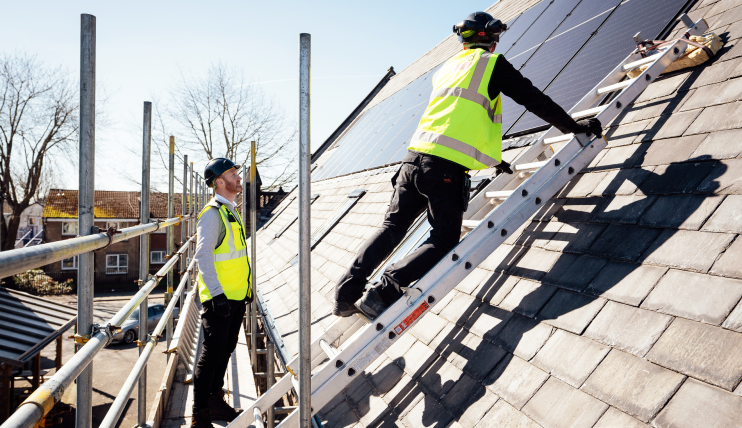

Commercial solar can make a strong financial case, but the upfront investment is often what stops a viable project moving forward.
A business might have the roof space, the daytime electricity demand and a clear opportunity to reduce its reliance on grid electricity, but still decide that investing a significant amount of capital in solar panels is not the right priority.
A Solar Power Purchase Agreement (PPA) offers another route. Rather than purchasing the solar PV system yourself, a third party can fund the installation and recover its investment by selling the electricity generated by the panels to your organisation over an agreed period.
For the business occupying the site, this can mean access to lower-carbon electricity and potential energy-cost savings without having to fund the full solar installation upfront.
Of course, a PPA isn’t the solution for every business. Over the lifetime of a well-performing system, outright ownership may offer a greater overall financial return. The key thing to remember is that PPA exchanges some of that potential return for lower capital requirements and, depending on the agreement, reduced responsibility for operating and maintaining the system.
So, how does a commercial Solar PPA work, which sites are suitable and what should you check before signing a long-term agreement?
What is a Solar Power Purchase Agreement?
A Power Purchase Agreement is a contract under which electricity is purchased from a generator at an agreed rate over an agreed period. The UK Government describes PPAs as long-term electricity purchase agreements between generators and buyers, which can include businesses buying electricity for their own use.
For an onsite commercial solar PPA, the arrangement commonly looks like this: A PPA provider finances the solar PV installation on your building. The provider owns the system and will normally be responsible for maintaining and monitoring it.
Your organisation doesn’t buy the solar panels; rather, you agree to purchase the electricity they generate at the rate set out in the PPA.
A current Department for Education solar PPA scheme uses precisely this model: a private provider finances, installs and maintains the panels without an upfront capital cost to the customer, while the customer purchases the generated electricity at a pre-agreed rate.
The result is that two things remain separate:
The solar panels belong to the PPA provider, while your business buys the electricity produced by them.
If the agreed PPA electricity price is lower than the equivalent cost of purchasing that electricity from the grid, the business can begin saving without first buying the solar installation itself.
How does a commercial Solar PPA work?
Every project and agreement is different, but a commercial rooftop Solar PPA will usually begin in much the same way as an owner-funded solar project.
Site assessment
First, the proposed installation needs to be technically and commercially viable.
That means looking at factors including:
- Electricity consumption
- Daytime load
- Roof space
- Roof condition
- Orientation and pitch
- Shading
- Electrical infrastructure
- Structural suitability
- Access
- Potential system capacity
- Expected solar generation
The objective is to establish how much solar electricity the site can realistically produce and, importantly, how much of that electricity the business is likely to use.
Financial modelling
Once the potential system has been established, the expected electricity generation can be compared against the site’s consumption.
For a PPA provider, this is fundamental. The economics rely on the system producing electricity that somebody will buy.
A commercial facility with a high and predictable daytime electrical load can therefore be particularly well suited to rooftop solar.
The modelling should consider both the expected generation and how much will be consumed behind the meter rather than exported.
PPA proposal
The provider can then propose a commercial structure setting out matters such as:
- The initial electricity price
- Contract duration
- Any annual price increase or indexation
- Expected generation
- Maintenance responsibilities
- Access requirements
- Metering
- Insurance
- Ownership
- End-of-term arrangements
It is important to look beyond the headline electricity rate. A low starting tariff can be less attractive if the price escalates aggressively over a long contract.
Legal agreement
Because a Solar PPA can affect energy purchasing, a physical building and a long-life asset installed on the roof, the legal agreement deserves proper scrutiny.
Depending on the site, this can involve the building owner, occupier, landlord, lender and PPA provider.
This stage should establish exactly what happens under both normal and less predictable circumstances: roof repairs, business relocation, property sale, system underperformance, access requirements and the eventual end of the agreement.
System design and installation
Once the agreement is complete, the solar installation can move through detailed design, procurement and installation.
That includes panels, inverters, mounting systems, electrical infrastructure, isolators, monitoring and any associated works required to connect the system safely into the site’s electrical infrastructure.
Grid connection
The appropriate Distribution Network Operator process also has to be followed.
Small, fully type-tested generation installations may fall under Engineering Recommendation G98, which applies up to 16 A per phase, while larger generation generally follows the G99 connection process. G100 covers customer export and import limitation schemes, which may be relevant where the amount exported onto the distribution network needs to be controlled.
For most substantial commercial rooftop installations, grid-connection requirements should therefore be considered early rather than treated as an administrative task at the end of the project.
Operation and billing
Once operational, the system generates electricity during daylight hours.
Electricity used directly by the building is measured and billed according to the PPA agreement.
The site’s normal electricity supplier remains important because solar will not usually provide all of the electricity a commercial building requires. When demand exceeds solar production, the additional electricity still needs to come from the grid or another source.
The PPA provider will normally monitor the solar installation and undertake the maintenance responsibilities established within the contract.
Why do businesses consider Solar PPAs?
The most obvious advantage is avoiding a large upfront capital purchase.
If a proposed rooftop system would cost £100,000, £250,000 or £500,000, a business may decide that its available capital would be better used elsewhere.
A PPA potentially allows the solar project to proceed anyway.
Lower upfront capital requirement
The business doesn’t normally purchase the solar array, so a substantial capital project can potentially become an electricity-purchasing arrangement instead.
That can be particularly useful where there are competing demands on capital.
Potential electricity savings from the start
A well-structured PPA aims to provide solar electricity at an attractive rate compared with the equivalent grid electricity cost.
That can allow the business to begin benefiting financially from solar generation without first waiting for a capital investment to pay back.
Greater energy-price predictability
A PPA establishes how the solar electricity price will be calculated over the agreement.
That doesn’t remove exposure to grid electricity altogether, but it can make part of the organisation’s energy cost more predictable.
The Government’s 2026 review of Corporate PPAs specifically identifies longer-term pricing certainty as one of their potential benefits for electricity buyers.
Reduced maintenance responsibility
Depending on the agreement, maintenance and monitoring remain with the owner of the system rather than the organisation using the electricity.
This can be attractive to businesses that want the benefits of onsite generation without adding another significant infrastructure asset to their own maintenance responsibilities.
Support for sustainability objectives
Using electricity generated by solar panels installed directly on the premises can contribute towards an organisation’s wider decarbonisation strategy.
For businesses with customer, procurement or corporate ESG commitments, onsite renewable generation can therefore deliver benefits beyond the electricity bill.
Solar PPA vs buying solar panels outright
One isn’t automatically better than the other. They solve different financial problems.
Buying outright
When you purchase the system yourself:
- You fund the installation
- You own the equipment
- You retain the full value of the electricity savings
- You are responsible for the asset
- You can potentially benefit from applicable capital allowances
- There is no PPA electricity charge
- You have greater control over the system in the future
The main disadvantage is the initial capital requirement.
Solar PPA
Under a typical PPA:
- The third party funds the system
- The third party owns the equipment
- You purchase the generated electricity
- Maintenance is usually handled by the provider
- Your upfront capital requirement can be substantially lower
- You commit to a longer-term contractual arrangement
- Some of the financial benefit goes to the provider in return for funding the asset
The trade-off is therefore fairly straightforward.
Buying solar maximises ownership and can maximise the potential long-term return.
A PPA prioritises capital preservation and transfers much of the asset responsibility to somebody else.
For some businesses, ownership is clearly preferable.
For others, having £250,000 available for machinery, expansion or working capital is more valuable than maximising the return from the solar installation itself.
READ MORE: How to finance commercial solar panels
How much could a Solar PPA save?
There isn’t one meaningful national number; the saving depends on the individual project.
At its simplest, the financial benefit is influenced by the difference between the PPA electricity rate and the cost of the electricity that the solar generation replaces.
But several other factors affect the result.
The PPA tariff
The starting electricity rate obviously matters, but so does what happens to that price in year five, ten or fifteen.
Check whether the tariff is:
- Fixed
- Increased by a set percentage
- Linked to inflation
- Reviewed against another index
Long-term PPAs can provide pricing stability, but government analysis also notes that price structures can include indexation or escalation arrangements.
Always model the whole agreement rather than comparing only the first-year rate.
Your grid electricity cost
The more expensive the electricity being displaced, the greater the potential value of onsite solar generation.
But future electricity prices are uncertain, which is why assumptions should be tested rather than simply extrapolating today’s tariff indefinitely.
How much solar electricity you actually use
This is one of the most important factors.
Solar electricity used directly by the business can replace imported electricity.
If much of the solar production is exported because the building doesn’t need it at the time it is generated, the economics will change.
That makes the site’s consumption profile as important as its roof size.
System performance
Orientation, shading, system design and component performance influence annual generation.
A PPA proposal should therefore be based on a proper technical assessment rather than a simple roof-area calculation.
What makes a site suitable for a Solar PPA?
Not every commercial property will be equally attractive.
A suitable roof
There needs to be enough usable roof area for a commercially viable array.
But size isn’t the only factor.
Condition matters too.
Putting a long-term solar system onto a roof that is likely to require replacement in a few years creates an obvious problem, particularly when the solar asset is owned by somebody else.
Roof condition should therefore form part of the assessment before the PPA is agreed.
Good daytime electricity consumption
Solar generates during daylight hours, so businesses that use significant electricity during those periods are particularly interesting candidates.
Manufacturing facilities, warehouses, offices, leisure facilities and other daytime operations may therefore have useful consumption profiles.
What matters is the actual interval consumption data, not the sector label.
Structural suitability
The building needs to be capable of supporting the installation.
A structural assessment may be required to confirm that the roof can safely accommodate the panels, mounting system and associated loads.
Limited shading
Trees, adjacent buildings, rooftop plant and the geometry of the building can all reduce generation.
That doesn’t necessarily rule out the project, but shading needs to be included honestly in the performance model.
Long-term occupation
A PPA is a long-term agreement attached, in practical terms, to infrastructure installed on a particular building.
The stronger the certainty around occupation of that building, the easier the arrangement generally becomes.
Short remaining lease terms, planned relocation or a possible property sale all need careful consideration.
Solar PPAs and battery storage
Battery storage can sometimes be incorporated into the wider energy strategy alongside a PPA-funded solar installation.
Solar panels don’t necessarily generate electricity at exactly the same time a business needs it.
A battery can store some surplus generation for use later, potentially increasing the amount of solar electricity consumed on site.
Depending on the site’s tariff and electricity profile, batteries may also form part of strategies around:
- Peak demand
- Time-of-use tariffs
- EV charging
- Energy resilience
- Import management
But battery storage isn’t automatically worthwhile simply because a solar system is being installed.
It adds additional cost and complexity, so its financial value should be modelled separately.
A site already consuming nearly all of its solar generation during daylight hours could have a very different battery business case from one exporting significant amounts of electricity every afternoon.
The commercial structure also needs to be clear. Is the battery owned by the PPA provider? Is it funded separately? Who controls when it charges and discharges? How is stored electricity priced?
Those questions should be answered before battery storage is added to the agreement.
Solar PPAs and EV charging
EV charging can complement commercial solar particularly well when vehicles are parked at the site during daylight hours.
A workplace with employee charging or a fleet depot with vehicles returning during the day may be able to use part of its solar generation directly for charging.
For a business planning fleet electrification, it can therefore make sense to consider future EV demand when the solar system is being designed.
Otherwise, the organisation could install an array based entirely on today’s electricity profile and then discover that its demand changes substantially two years later.
Battery storage can add another dimension by allowing solar electricity generated at one point in the day to contribute towards charging at another.
The important point is to design the energy infrastructure as a whole.
Solar, battery storage, EV charging and the building’s existing electrical load all interact.
Planning permission and grid connection
Planning and grid approval are separate issues, and both should be checked during the project-development stage.
Does commercial rooftop solar need planning permission?
In England, solar equipment on non-domestic buildings can fall under permitted development rights under Class J of Part 14 of the General Permitted Development Order, provided the relevant limitations and conditions are satisfied.
That doesn’t mean every commercial solar installation can simply proceed without checks.
Factors including the building’s status, the positioning and dimensions of the array and the nature of the site can affect the position. Listed buildings and scheduled monuments have specific restrictions under Class J. Larger non-domestic rooftop schemes can also involve a prior-approval process rather than simply proceeding without reference to the local planning authority.
Leasehold properties add another consideration: even where planning permission isn’t required, landlord or freeholder consent may still be necessary.
Planning requirements also differ elsewhere in the UK, so the rules applicable to the actual project location should always be checked.
What are G98, G99 and G100?
Connecting solar PV to the electricity network is governed separately from planning.
Energy Networks Association guidance distinguishes between G98 connections for fully type-tested microgeneration up to 16 A per phase and the G99 process for other generation connecting in parallel with the public distribution network.
For larger commercial systems, a G99 application will therefore commonly be relevant.
G100 relates to customer export and import limitation schemes. For example, a solar system may have more generation capacity than the network is willing to accept as export, but an approved export-limitation arrangement may restrict the amount actually flowing back onto the grid.
The appropriate route depends on the proposed system and connection, so grid requirements should be assessed during design rather than after the installation has been finalised.
What Solar PPA contract terms should you check?
The panels may be relatively straightforward.
The contract deserves considerably more attention.
Contract length
How long are you committing to buy the electricity?
What happens if your organisation’s requirements change during that period?
Electricity rate
Make sure you understand the starting tariff and precisely what electricity that tariff applies to.
Rate increases
Does the tariff stay fixed or increase?
If it increases, is that by a fixed percentage or linked to an index?
Small annual increases compound over long contracts, so model the rate in later years rather than concentrating solely on year one.
Minimum purchase requirements
Does the agreement require you to purchase a minimum amount of electricity?
What happens if your consumption falls because production reduces, the building is partially vacated or operating hours change?
Performance assumptions
What annual generation is being assumed?
Who carries the risk if the system underperforms?
How will performance be monitored?
Ownership
Confirm who owns each element of the system and whether that changes during or at the end of the agreement.
Maintenance
Who handles routine maintenance?
Who pays if an inverter fails?
What response times apply?
Roof access
The provider may need access to inspect, maintain and repair equipment.
The agreement should set out how this works and how access is managed around your own operations.
Roof repairs
This one deserves particular attention.
What happens if the roof needs repair halfway through the agreement and the panels have to be temporarily removed?
Who pays for removal and reinstatement?
Insurance
Make sure responsibility for insuring the equipment and any associated liabilities is clear.
Break clauses and early termination
What happens if you want to leave the agreement early?
Long-term flexibility can be as important as the starting electricity price.
Buyout provisions
Can you purchase the system during the contract?
If so, how is the price calculated?
Property sale or lease expiry
Can the agreement transfer to a buyer or new tenant?
What happens if they don’t want to take it on?
These questions can become extremely important years after the original solar proposal has been forgotten.
What happens at the end of a Solar PPA?
There isn’t one standard outcome.
Everything depends on the agreement you sign at the beginning.
Possible arrangements can include:
- Extending the PPA
- Purchasing the solar installation
- Transferring ownership
- Agreeing a new electricity arrangement
- Removing the equipment
This is why end-of-term provisions deserve attention at contract stage rather than in the final year.
If you expect to buy the system eventually, understand how that buyout price will be calculated.
If ownership will transfer automatically, establish what condition and maintenance records should accompany the system.
If removal is an option, clarify who pays for the work and for reinstating the roof afterwards.
Risks and considerations before signing a Solar PPA
A PPA can remove a major barrier to commercial solar, but it isn’t simply “free panels and cheaper electricity”.
You are entering a long-term commercial relationship.
You sacrifice some of the potential upside
The PPA provider is funding the installation and taking investment risk.
They therefore need to make a return.
If your business has sufficient capital to purchase the system itself, outright ownership may generate greater lifetime savings.
The right comparison is not solar versus no solar.
It is PPA solar versus financed solar versus owned solar.
Your building circumstances may change
Twenty years can encompass several lease renewals, expansions, acquisitions or property decisions.
An agreement that works perfectly for today’s business still needs sensible provisions for tomorrow’s.
Electricity-price forecasts can be wrong
A PPA may look particularly attractive against today’s grid price.
Nobody knows exactly where electricity prices will be many years from now.
That means price escalation and review mechanisms need to be tested against several scenarios.
The Government’s current review of the wider corporate PPA market similarly highlights the need for businesses to assess long-term market uncertainty and the contractual allocation of future risks carefully.
Creditworthiness may matter
The provider is investing capital upfront based partly on the expectation that your organisation will continue buying electricity over a long period.
Long-term PPAs therefore create counterparty risk for the investor, and government analysis identifies creditworthiness as an important consideration in the broader CPPA market.
The roof remains part of the equation
Even the strongest energy proposition can become problematic if the building itself isn’t suitable for a long-term installation.
Roof surveys, lease reviews and future maintenance plans matter.
Solar PPA FAQs
Is a PPA the same as leasing solar panels?
Not quite.
With a PPA, the central transaction is the purchase of the electricity produced by a third-party-owned system. Under a conventional equipment lease, the customer is paying to use the asset itself.
The distinction affects ownership, payment structure, maintenance responsibilities and potentially accounting and tax treatment.
Do I own the solar panels under a PPA?
Normally, no.
The PPA provider typically owns the solar PV system for the duration of the agreement. The contract should state whether you have the option to purchase it later or whether ownership can transfer at the end of the term.
How long does a commercial Solar PPA last?
There is no single standard term.
PPAs are generally long-term arrangements because the provider needs sufficient time to recover the cost of installing the generating asset and earn its return. UK Government guidance likewise characterises PPAs as long-term electricity-purchasing agreements.
The specific duration should be considered alongside your expected occupation of the building and future property plans.
Can electricity still be exported to the grid?
Potentially, yes, but who receives the benefit of exported electricity depends on how the agreement has been structured.
Because the PPA provider owns the generation asset, don’t assume that export revenue automatically belongs to the site occupier.
Export arrangements, metering and ownership of any associated revenue should be stated clearly in the contract.
Can a Solar PPA include battery storage?
Potentially.
Battery storage may be incorporated into the wider project or funded separately. If it forms part of the PPA arrangement, the agreement should specify ownership, operation, maintenance and how stored electricity is charged.
What happens if I move premises?
This depends entirely on the contract and property arrangements.
Possible outcomes might include transferring the agreement to a new occupier, buying out the system or terminating under agreed provisions.
If there is a realistic possibility that your business could relocate during the proposed PPA term, deal with that scenario before signing.
Does the PPA provider maintain the panels?
Under a typical onsite PPA model, the system owner usually retains maintenance responsibility. The Department for Education’s current solar PPA model, for example, places both maintenance and performance responsibility with the private-sector provider.
Your individual contract should nevertheless define exactly what maintenance is included and how problems will be managed.
Is a PPA always cheaper than buying solar panels?
Not necessarily.
A PPA can make solar accessible without the same upfront expenditure, but the provider needs to recover its investment and generate a commercial return.
For a business with sufficient available capital and a long-term interest in the site, purchasing the system can potentially provide a stronger lifetime financial return.
The two options should be modelled side by side.
How Hybrid Asset Solutions can support commercial solar projects
Choosing a funding model should come after understanding what solar can actually achieve on the site.
Hybrid Asset Solutions can assess the building, electricity consumption and available roof space before designing and modelling an appropriate commercial solar PV system.
That includes considering:
- Expected annual solar generation
- On-site electricity consumption
- Grid electricity reduction
- Roof orientation and shading
- System size
- Grid-connection requirements
- Battery storage
- Commercial EV charging
- Potential export
- Projected savings and payback
Once the underlying system has been modelled, different funding routes can be compared on the same basis.
That might mean purchasing the system outright, using commercial finance to spread the capital cost or exploring whether a Solar Power Purchase Agreement provides a better fit for the organisation.
The objective shouldn’t be to make the PPA look best.
It should be to work out which route makes the strongest commercial sense for the site and the business behind it.
Discuss your commercial solar options
A Power Purchase Agreement can remove one of the biggest obstacles to commercial solar: finding the upfront capital to pay for the installation.
But a zero-upfront-cost project isn’t automatically the cheapest option over its entire life.
Before making a decision, understand the system first.
How much electricity could your roof realistically generate? How much could you use on site? How much could that save? What would outright ownership cost? What would finance look like? And what would you give up – or gain – by choosing a PPA instead?
Hybrid Asset Solutions can model those options against your actual building and electricity consumption, giving you a clearer comparison between outright purchase, commercial finance and a Solar Power Purchase Agreement.
Book a commercial solar survey to understand what your site could generate and which funding route could work for your organisation.